There have been widespread criticism from individuals spanning the political spectrum. You have the usual suspects from the left vilifying the greedy behavior of American Airlines putting the pursuit of short-term profits at the sake of long-term stability and their employees. On the other side the ardent capitalists are decrying crony capitalism where American is using its large political influence to extract taxpayer money to cover their loses. With memories of the 2008 financial crisis and subsequent bailouts still fresh in people’s minds. The idea of giving money to businesses that behaved recklessly who will then turn around and give themselves large bonuses will not sit well with many Americans that are currently unemployed.
:no_upscale()/cdn.vox-cdn.com/uploads/chorus_asset/file/19866738/unemployment_chart_2_UPDATE.jpg)
Nicholas Nassim Taleb
Author Nicholas Nassim Taleb who works include: The Black Swan, Antifragile, and Skin in the Game. Wrote a blog post in response of the corporate bailouts being offered to Boeing and the Airlines. He has also been critical of the bank bailouts of 2008 and the phenomenon of “privatizing profits and socializing losses.” He also wrote in The Black Swan in 2007 that due to our increased level of interconnection that an pandemic would be inevitable and should not be considered a black swan event. In the Bloomberg interview below he explains why the bailout for corporations that did not reasonably create a cash buffer or get insurance for this kind of event should not rewarded for their irresponsibility.
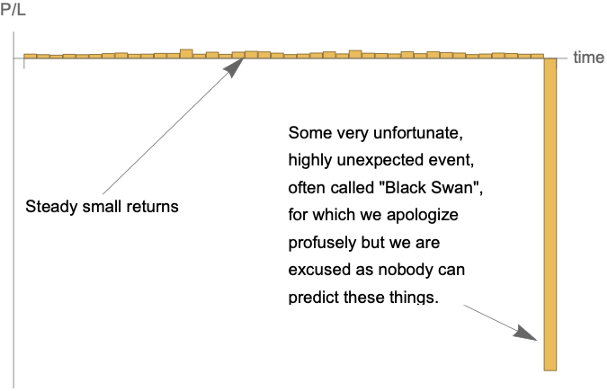
Above is a chart from his blog post “Corporate Socialism: The Government is Bailing Out Investors & Managers Not You” and it demonstrates that the airlines such as American have been taking excess risk over the past decade by not having a buffer, buying back shares, large executive compensation are not planning on assuming that risk but is instead transferring that risk for the public.
Jonathan Tepper
Jonathan Tepper wrote a with Denise Hearn called the The Myth of Capitalism were he breaks down the degree to which our economies have been dominated by monopolies and the knock on effects that this has on our society. He also founded investment research firm Variant Perception.
He wrote an essay titled “Covid-19 has exposed our financial fragility -An orgy of borrowing, speculation and euphoria has left the markets on the verge of catastrophe” in which he discusses how fragile our economic system was going into this crisis and how the problems that led up to 2008 where never fixed and have inevitably led us to this current moment. He takes a big picture macro-economic view of the situation and it explains how this current moment is so economically disruptive to our society. Since the financial crisis central banks have been suppressing risk and volatility and allowing large companies to borrow cheap debt in order to stimulate financial assets which may in turn stimulate economic growth. But by not allowing companies to fail and bankruptcy processes to occur both investors and managers are not encouraged to manage risk and responsible businesses are not rewarded for their behavior.
Forest fires are a useful analogy. California has infrequent, devastating forest fires; the Mexican state of Baja California has many small frequent fires and almost no major catastrophic fires. Both states have a similar climate and vegetation, yet they have vastly different outcomes. That’s because when there are very few small fires, underbrush grows, vegetation increases and creates greater kindling for the next fire. Suppressing small risks only makes them emerge eventually as very big ones.
Jonathan Tepper
This quote from Jonathan is a helpful analogy of the effect of risk suppression and how it is like energy in that it cannot be created or destroyed only transferred. As a result of this excessive financial engineering via share repurchases and debt issuance these companies have created a fragile system where a biological problem is creating another once in a century financial crisis. The most heinous example of this is Boeing which bought back $100 billion dollars worth of their shares and caused the deaths of hundreds from their poorly designed 737 max aircraft. Boeing put financial engineering ahead of real engineering which is troubling from an aircraft manufacturer who is now begging the government for a handout so they can survive. Whereas the airlines bought back 96% of their free-cash flow on share repurchases instead of preparing for a rainy day which they should be anticipating. Due to their exposure to energy market fluctuations, terrorism, and diseases.
These companies risk their long term profitability if they take this government money. To continue the theme of risk transfer, they will effectively be transferring the financial risk of their poor decisions to the politics. After the dust settles it is unlikely that government authorities will allow there past behaviors to continue. Especially if they take the bailout money. Using 2008 as a guide, stories of large bonuses and unethical management behavior will come out that will fuel public anger and weaken government credibility.
Dr. Ben Hunt
Dr. Ben Hunt is a former political science professor, hedge fund manager, and founder of the blog Epsilon Theory. In this interview with NBC news he discusses how a lot of large publicly traded companies have consciously hollowed themselves out for the sake of the enriching the executives through what he called the holy trinity:
- More Debt
- More sharebuybacks
- Larger executive compensation tied to share price
American Airlines CEO Doug Parker has not taken a salary since 2015 and has instead has taken all of his compensation in the form of stock rewards. Stock-based compensation was intended to solve the agency problem where it would align the incentives of the managers with the incentives of the company shareholders. However, the incentives become perverse when the time-frame of the holding period of the executives is much shorter than that of a shareholder saving for a retirement or at a pension fund. Where long term steady returns are more important. The executives then choose to transfer cash from the company’s balance sheet to their own wealth by recommending and authorizing share repurchases to artificially inflate the share price. Then when an inevitable economic slowdown occurs the company (shareholders, employees, suppliers) are now left at risk of loosing everything while the executives who failed to prepare are now incredibly wealthy.
 Site Title
Hi Alex,
I think you and those references have demostrated the agency problem thoroughly, and I agree with those ideas at a large extent. I believe such conflict cannot be solved in a short period, it will definitely result in a deep reformation of the company. I also believe that the one and the only way to solve the problem of externality is introducing externality – using strict legislations to restrict the power of management. We do need to escalate something into the height of legislation when ethics is out of order. The agency problem even becomes worse in non-profit organizations, as the probability of the tragedy of commons will surge.
LikeLiked by 1 person
Hi Alex,
American Airlines prioritize profit and take advantage of the situation to resolve their financial issues. It is unethical to want to extract taxpayer money to cover their losses. Where are equity and justice in our society? I think giving out money to corporations won’t solve that much crisis. Also, I believe the government should prioritize the public health systems to get this disease out of here as soon as possible otherwise the economy won’t get back to normal. People have to be safe and healthy first then the rest should follow. Lives matter. I agree that the government should bail out citizens and employees instead of giving around $25 billion to the Airline Industry. They are not the only industry affected by this pandemic. Everybody needs help somehow at this time.
LikeLike